← Back to Workshop 0 Go to Exercises →

Workshop 0: Final Test

Task 1: Component Identification

▼ Show

Task: Drag the component images from the left to the correct labeled boxes on the right. If correct, the image will disappear. If wrong, it will return to its original position.

Component 1 Component 2 Component 3 Component 4 Component 5

Drop components here:

Resistor
Drop image here
Capacitor
Drop image here
LED
Drop image here
Diode
Drop image here
Transistor
Drop image here
Other Component
Drop image here

Task 2: True or False

▼ Show

Task: For each statement, select whether it is True or False.

Statement 1: A resistor limits or controls the flow of electric current in a circuit.
Statement 2: In an LED, the longer leg is the negative (cathode) terminal.
Statement 3: A capacitor stores electrical charge and is often described as a "bucket of charge".
Statement 4: A diode allows current to flow in both directions (forward and reverse).
Statement 5: According to Ohm's Law, voltage equals current multiplied by resistance (V = I × R).
Statement 6: A potentiometer can function as a voltage divider.
Statement 7: VCC typically refers to the supply voltage (positive voltage supply).
Statement 8: GND means "general neutral level".
Statement 9: There are several different types of capacitors.
Statement 10: A capacitor may explode if it is connected incorrectly (wrong polarity).
Statement 11: If a circuit has too small a resistance, the wires may melt.
Statement 12: When measuring current with a multimeter, you must check that the meter's maximum current limit is not exceeded.
Statement 13: Resistance can be measured using the voltage setting on a multimeter.
Statement 14: A transistor can act as a switch.
Statement 15: AC stands for Alternating Current.
Statement 16: DC stands for Direct Current.
Statement 17: A battery typically provides DC voltage.
Statement 18: A silicon diode typically has a forward voltage drop of about 0.7 V.
Statement 19: A transistor has three terminals.
Statement 20: A voltage divider circuit uses two resistors.
Statement 21: If a battery is marked 9V, it means it can supply 9 amperes of current.
Statement 22: There are two main types of transistors: current-controlled and voltage-controlled.
Statement 23: A transistor can control high power with very small power.
Statement 24: Capacitance describes the properties of a transistor.
Statement 25: In a battery, current flows from lower voltage to higher voltage.
Statement 26: When a circuit is closed, part of the current flows outside the circuit.
Statement 27: A fuse is designed to protect an electrical circuit.
Statement 28: The value of a fuse is typically specified in Amperes.
Statement 29: In household use, 10W is a typical power rating for an LED lamp.
Statement 30: In a car, a lamp marked 12V and 1A consumes 12W of power.

Task 3: Measurement

▼ Show

3.1: Measure Resistance and Current

▼ Show

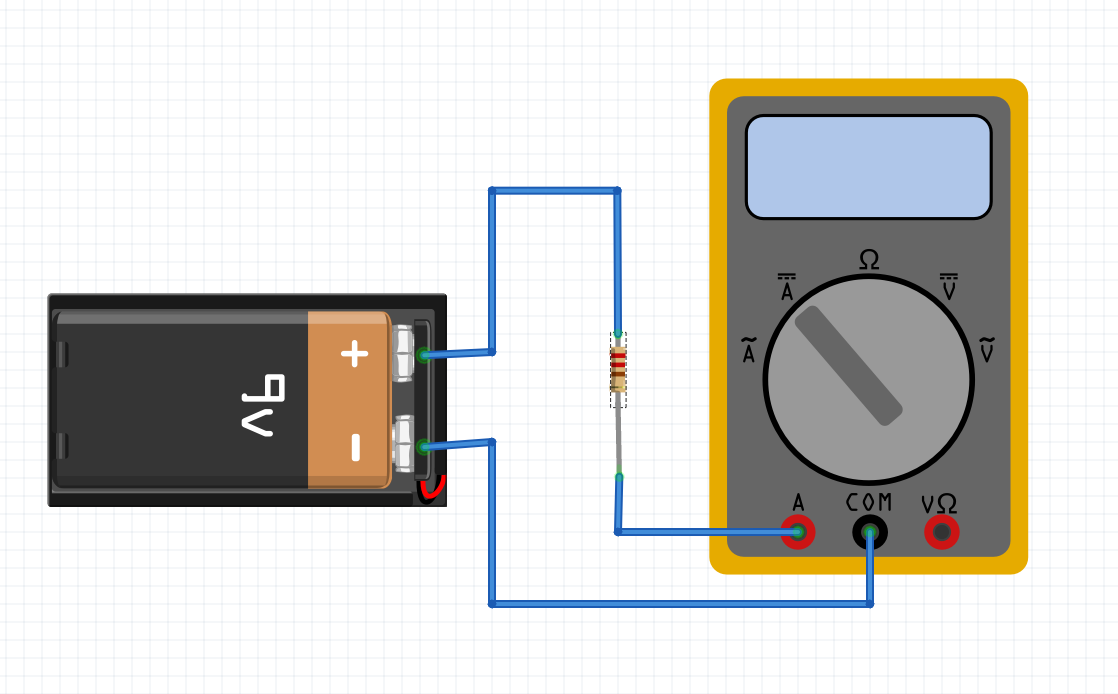
Task: Measure the resistance and current. Enter the values below and calculate.

Resistance Measurement

Measure Resistance

Current Measurement

Measure Current

Step 1: Enter Values

Step 2: Enter Your Current Measurement

Step 3: Calculated Value

Expected Current: Click Calculate to see result

3.2: Voltage Divider Measurement

▼ Show

Task: Build a voltage divider circuit as shown in the image. Measure the components and voltages, then enter the values below. The correct values will be calculated automatically when you click Calculate.

Notice: When measuring resistance, do not apply voltage.

Voltage Divider Circuit

Step 1: Measure Components

Step 2: Measure Voltages

Step 3: Calculated Values

Expected Voltage across Upper Resistance: Click Calculate to see result
Expected Voltage across Lower Resistance: Click Calculate to see result

3.3: Potentiometer Measurement

▼ Show
Potentiometer Test Circuit

Warning: Before connecting power, always verify that VCC and ground connections are correct. Incorrect connections may cause a short circuit. In any circumstance, the potentiometer should not get heated up. If you cannot touch it, something is seriously wrong.

What is Potentiometer?

Task: Take random two resistance R1 and R2. Put them in breadboard as following picture shows. The potentiometer is on the right, and the measurement is taken from the center pin. Adjust the potentiometer until the voltage difference between point A and A is zero. Can you determine the resistor 1 and 2?

Can you determine the ratio of R1 and R2 from potentiometer?

This circuit configuration is very common and is known as the Wheatstone bridge. It has many applications in electronics, for example in strain gauge measurements.

3.4: LED Sizing (Extra)

▼ Show

Extra

Common LED Specifications

Forward Voltage (Vf):

  • Red: 1.7V - 2.1V
  • Green: 2.0V - 2.2V
  • Blue/White: 3.0V - 3.3V

Forward Current: Typically 20mA (0.02A)

Task: Size the LED correctly using the calculator on the right. Check your result.

LED almost always needs a protective resistor. As a rule of thumb, approximately 100 ohms. The resistor can be on either side of the LED.

More precisely, the resistor size can be calculated using Ohm's Law: R = (Vsupply - VLED) / ILED

It is essential to know how much current the LED can handle, usually 20mA (milliAmp).

Accurate LED Resistor Calculator

Default: 5V (USB voltage)
Default: 1.7V (Red LED)
20mA (0.02A) is typical for LEDs
Enter supply voltage to calculate required resistance

Step 2: Enter Your Measured Resistance

About the Calculator

The accurate calculator uses the proper formula that accounts for the LED's forward voltage drop:

R = (Vs - Vf) / If
Where:
R = Required resistor value (Ω)
Vs = Supply voltage (V)
Vf = LED forward voltage drop (typically 1.8V-3.3V)*
If = LED forward current (typically 20mA = 0.02A)

*Common LED forward voltages:
Red: ~1.7V-2.1V
Green: ~2.0V-2.2V
Blue/White: ~3.0V-3.3V

Always choose a resistor value equal to or slightly higher than the calculated value. Never use a lower value as it may damage your LED.

Task 4: Line Follower Piippari

▼ Show

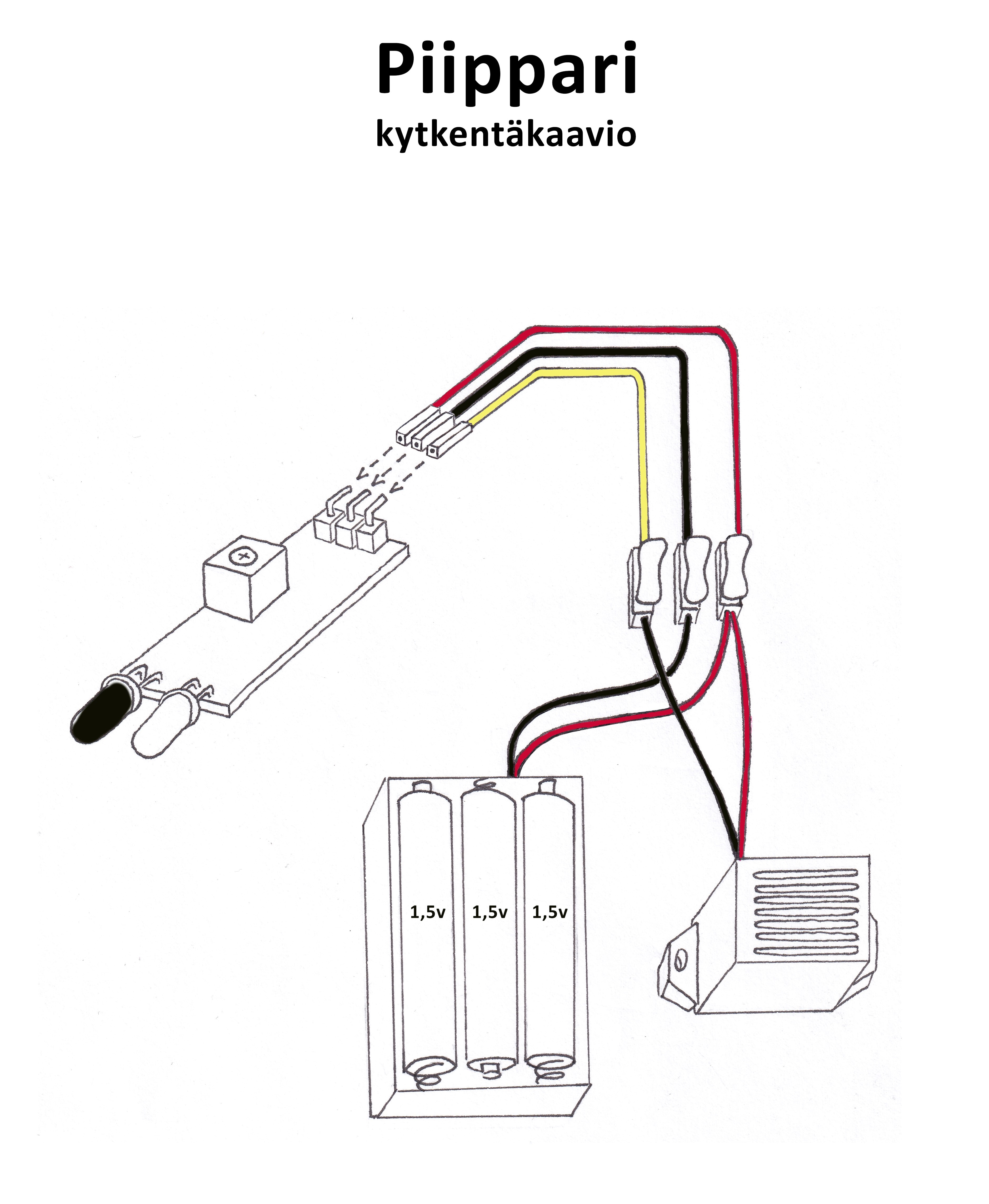
Task: Build the line follower (Piippari) based on the image.

Piippari kytkentäkaavio

What is a line follower device?

A line follower detects contrast between dark and light surfaces (typically using IR reflectance sensors). Black absorbs light → lower sensor signal; white reflects light → higher sensor signal. A threshold separates the two, and the output (buzzer or vibrator) is driven accordingly.

Instructions: Build the circuits shown in the images using the parts you received. Note: the battery positive terminal is marked in red (on the line follower this is labeled VCC). The negative terminal is black (on the line follower GND). The signal wire is a different color (in these diagrams green or white).

Wires: Choose the correct wire types: male–female, male–male, or female–female.

Sensitivity: Finally, adjust the line follower sensitivity with a small screwdriver. When the buzzer is over a black surface, it should be silent; when over a white surface, it should activate the buzzer. With the vibration motor (vibrator), the behavior is the opposite.

Testing: The line follower sensitivity must be adjusted with a screwdriver. Test it on a black object or a wide line.